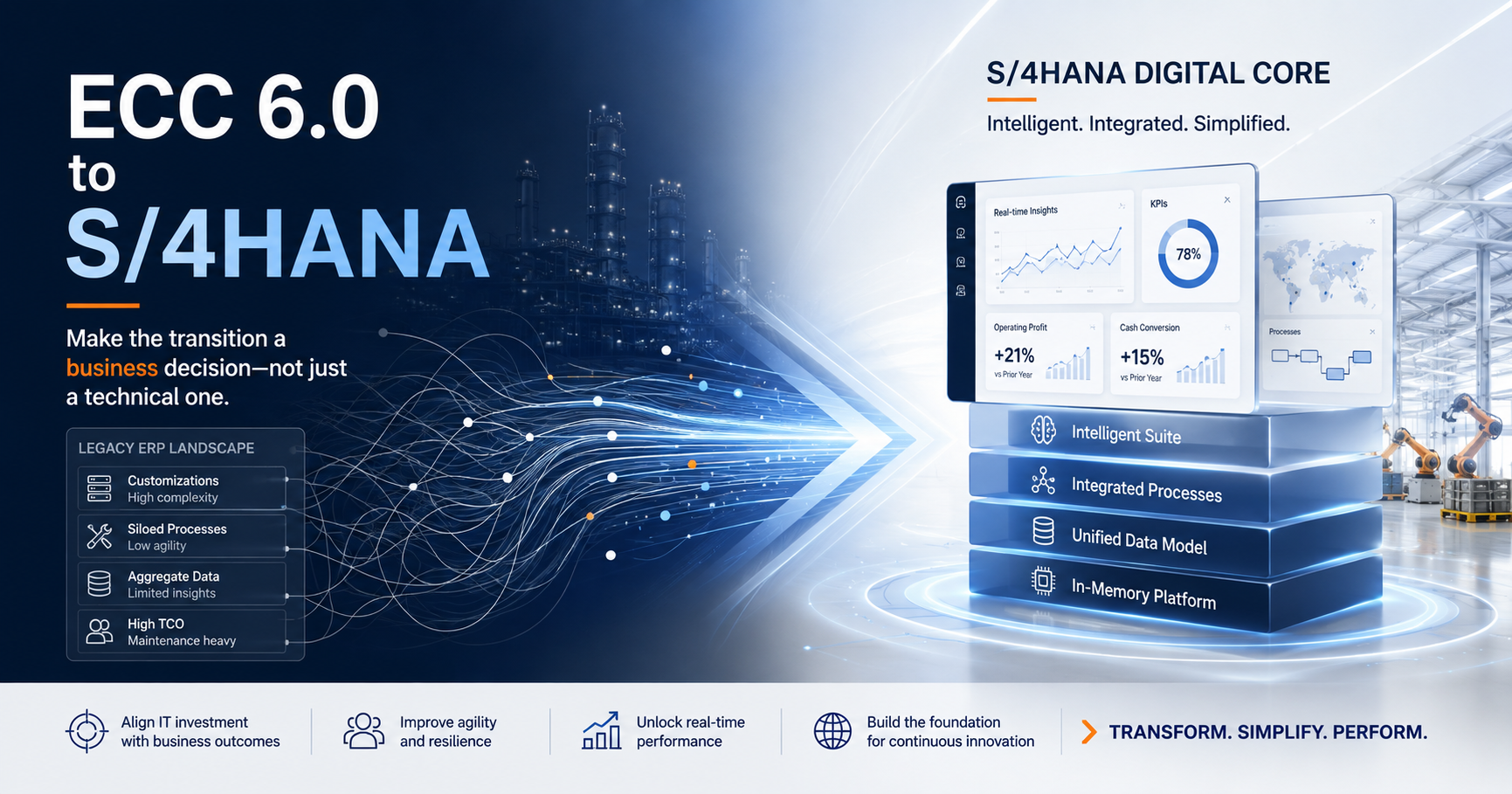
For organizations still operating SAP ECC 6.0, the move to S/4HANA is becoming increasingly difficult to treat as a distant planning exercise.
SAP’s mainstream maintenance for the latest Business Suite 7 core applications, including applicable SAP ERP 6.0 enhancement packages, is scheduled to run through the end of 2027, with optional extended maintenance available through the end of 2030.
Those dates create urgency.
But urgency can also create the wrong objective.
The question should not simply be:
How quickly can we move ECC to S/4HANA?
A better question is:
What should we take forward, what should we change, and what should the future SAP environment enable that the current one does not?
For many organizations, the S/4HANA transition may be one of the few opportunities they will have in years to examine accumulated process complexity, customizations, data, reporting practices and technology assumptions.
Simply reproducing all of that in a newer platform can mean carrying yesterday’s problems into tomorrow’s ERP environment.
Start With What Has Changed Since ECC Was Designed
Many long-running SAP environments reflect years—or decades—of business change.
Organizations acquire companies. Products change. Distribution models evolve. New compliance requirements appear. Employees create workarounds. Reports multiply. Custom developments accumulate.
The SAP environment adapts along the way.
Not every customization is a problem. Many exist for very good business reasons.
But before an S/4HANA transition, organizations should distinguish between:
- processes that remain strategically important;
- customizations that still address legitimate requirements;
- workarounds that developed because better alternatives were unavailable;
- data that still has operational or regulatory value;
- and complexity that simply accumulated over time.
That conversation should happen before the migration approach is locked down.
Brownfield, Greenfield—or Something Between Them?
There is no universally correct migration strategy.
SAP describes three broad transition approaches: system conversion, often called brownfield; new implementation, commonly called greenfield; and selective data transition, which provides a middle path that allows organizations to selectively retain or redesign parts of the existing environment.
The right answer depends heavily on the condition of the current system.
A system that is well governed, relatively standardized and strategically aligned may be a good candidate for conversion.
An environment with extensive process debt, outdated organizational structures or significant custom-code complexity may warrant more substantial redesign.
And some organizations may want to preserve particular processes and historical information while changing others.
The important point is that the migration method should follow the business objective—not the other way around.
Readiness Is More Than Technical Compatibility
Technical readiness matters.
SAP Readiness Check can analyze an existing SAP ERP environment and identify areas relevant to an S/4HANA conversion, including applicable simplification items and other conversion considerations. SAP describes simplification items as one of the important mechanisms for understanding what may need to change in an ERP 6.x system during conversion.
But a technically convertible system is not necessarily a business-ready system.
Organizations should also be asking:
- Are our processes still appropriate?
- Where are users working outside SAP?
- Which reports are still meaningful?
- Which custom developments are actually being used?
- Is our master data sufficiently reliable?
- Where do we have ownership or adoption problems?
- Which existing integrations should survive?
- What should become standard rather than custom?
These questions often have as much influence on transition effort and future value as the technical conversion itself.
Look Closely at the Workarounds
One of the most useful discovery exercises before an S/4HANA transition is simply to ask business teams:
Where do you leave SAP to get the work done?
Spreadsheets, manual reconciliations, offline approvals, email-based workflows and custom reports can reveal areas where the current process is no longer serving the organization particularly well.
Some of those gaps may be addressed through redesigned S/4HANA processes.
Others may be better addressed through workflow, analytics, automation or improved integration.
And increasingly, some may become candidates for AI-assisted capabilities.
The objective is not to eliminate every workaround.
It is to understand why it exists before deciding whether to reproduce it.
The AI Question Now Belongs in the S/4HANA Conversation
This is a relatively new consideration.
Historically, an ERP migration might focus primarily on infrastructure, functionality, process design, integrations and data.
AI is beginning to change the future-state discussion.
In 2026, SAP added SAP Business AI Capabilities to SAP Readiness Check for S/4HANA, providing visibility into Business AI capabilities—including generative and agentic scenarios and Joule-powered experiences—in relation to target S/4HANA environments.
That does not mean every S/4HANA migration should suddenly become an AI transformation program.
It does mean organizations should consider whether the future environment should make it easier to explore capabilities such as improved knowledge access, exception handling, decision support, process assistance and automation.
A migration design that considers only today’s requirements may unnecessarily constrain tomorrow’s opportunities.
Clean Up Before You Carry It Forward
Data deserves particular attention.
Moving everything simply because it already exists can increase migration effort and perpetuate poor-quality or obsolete information.
Organizations should understand what data is required for:
operational continuity, historical reporting, compliance, analytics, customer or supplier relationships, and future AI or automation scenarios.
Selective transition approaches can provide opportunities to leave some obsolete data or organizational structures behind rather than transferring everything indiscriminately.
The same principle applies to custom code.
The question should not be:
Can we make this custom development work in S/4HANA?
It should first be:
Do we still need it?
Think Beyond Go-Live
A technically successful migration can still leave substantial value unrealized if the organization treats go-live as the end of the journey.
Post-transition planning should consider adoption, process ownership, enhancement priorities, operational metrics and a mechanism for reviewing new S/4HANA capabilities over time.
It can also be useful to identify a small number of opportunities that do not need to be solved during the migration itself.
Trying to transform everything simultaneously creates unnecessary risk.
Some opportunities are better identified during transition planning, documented, and addressed once the new environment has stabilized.
That is particularly true for emerging AI capabilities.
A Better Definition of S/4HANA Readiness
Readiness should not simply mean:
“Our ECC system can be converted.”
A stronger definition is:
“We understand our existing environment, know what should change, have made deliberate decisions about what should move forward, and have a clear view of the business environment we want S/4HANA to support.”
That requires technical analysis.
But it also requires process understanding, business participation and disciplined prioritization.
The Opportunity Behind the Deadline
The maintenance timeline is a legitimate reason for ECC customers to act.
But it should not become the only reason.
An S/4HANA transition creates an opportunity to reassess how SAP supports the organization—and to make intentional decisions about process, data, customizations, integration, adoption and emerging capabilities before significant migration investment is committed.
At Answers4Business, our approach is to begin with that business context.
Drawing on more than two decades of SAP and ERP experience, A4B can help organizations assess their current environment, identify transition priorities and determine where focused SAP, process or specialist support may be required.
The goal is not simply to move systems.
It is to make better-informed decisions about what the next SAP environment should enable.
Considering a move from SAP ECC 6.0 to S/4HANA?